Menu Marvel
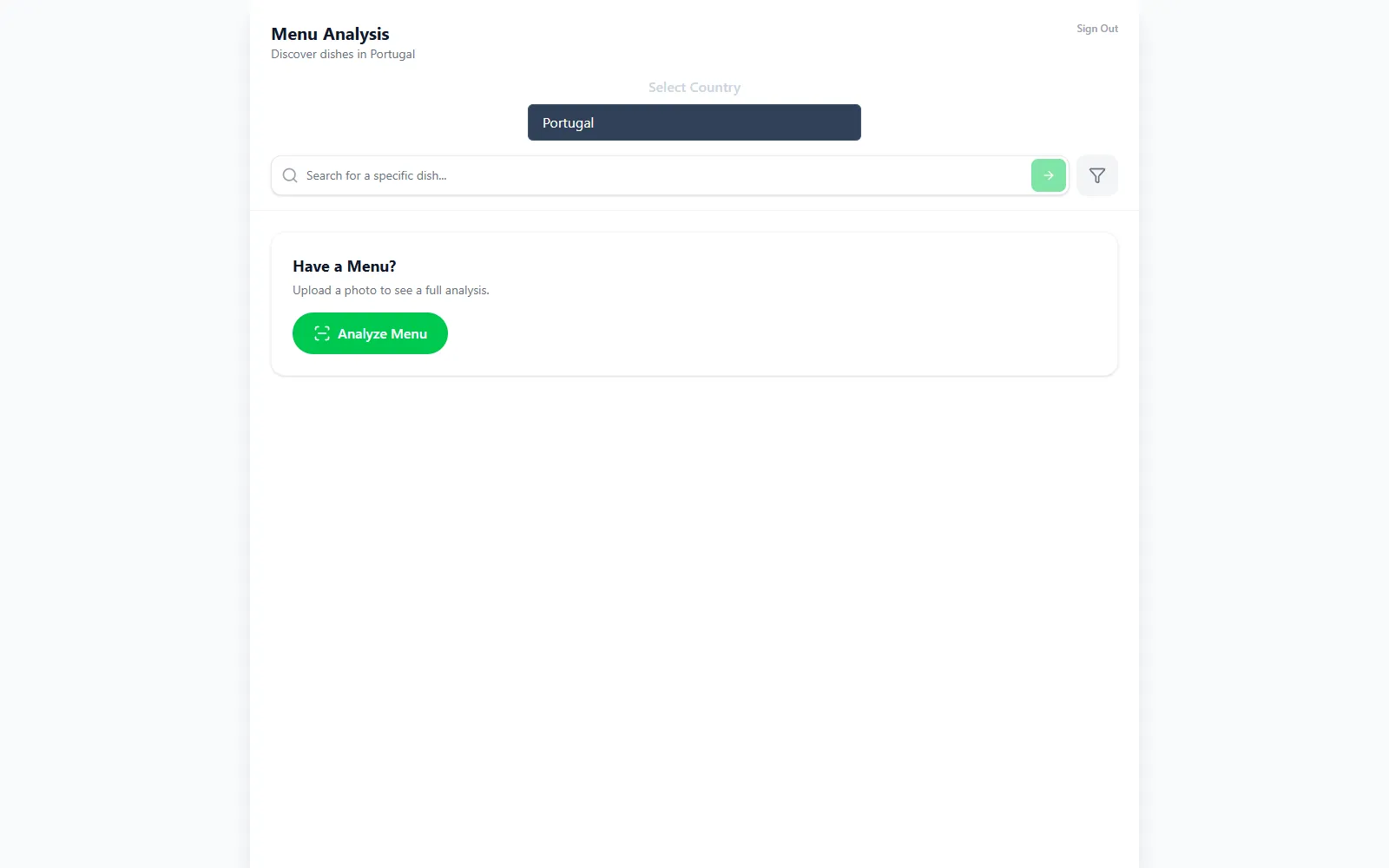
Point your phone at a menu in a language you don't read. Get it back translated, with a picture of every dish.
- Design, AI pipeline & full build
- 2025
- Next.js 16 · TypeScript · Google Gemini · Imagen 4 · Google CSE · Supabase
Fast, cheap, accurate: pick three.
You're travelling. The menu is in a language you can't read, there are no pictures, and pointing hopefully at a word is how you end up with tripe. Menu Marvel solves the whole loop: photograph the menu, get each item translated, and see an actual image of what the dish looks like. The engineering challenge is doing that fast enough to feel instant, cheaply enough to be free, and accurately enough to trust. Three goals that pull against each other.
My role: I built the product end-to-end. It started as a Google AI Studio prototype; I rebuilt it into a real Next.js app and designed the multi-stage pipeline that makes it fast and cheap.
A staged pipeline behind one endpoint.
A single endpoint runs the pipeline and streams results back as newline-delimited JSON. Gemini handles OCR and translation; the text ships to the client immediately, then image resolution runs per-dish in parallel. Images come first from Google image search (cheap and real), and an LLM grades each candidate before it's shown. Only when search fails does it fall back to generating an image with Imagen 4.
Where the senior work lives.
Stream the text, fill in the pictures.
Search first, generate last.
Deterministic where it can be, AI where it must be.
From prototype to product.
<2s
to first translated text on screen
2
image sources: real search, generated fallback
1
endpoint runs the whole staged pipeline
Live
running on Vercel
Arte de Saber Envelhecer
A self-owned website and blog for a real client, with no host lock-in.